Lakes Beneath the Ocean — When the Water Vanishes but the Evidence Remains
Researched and edited by Arcanum Research Desk · Entry last reviewed
This review date applies to this entry.
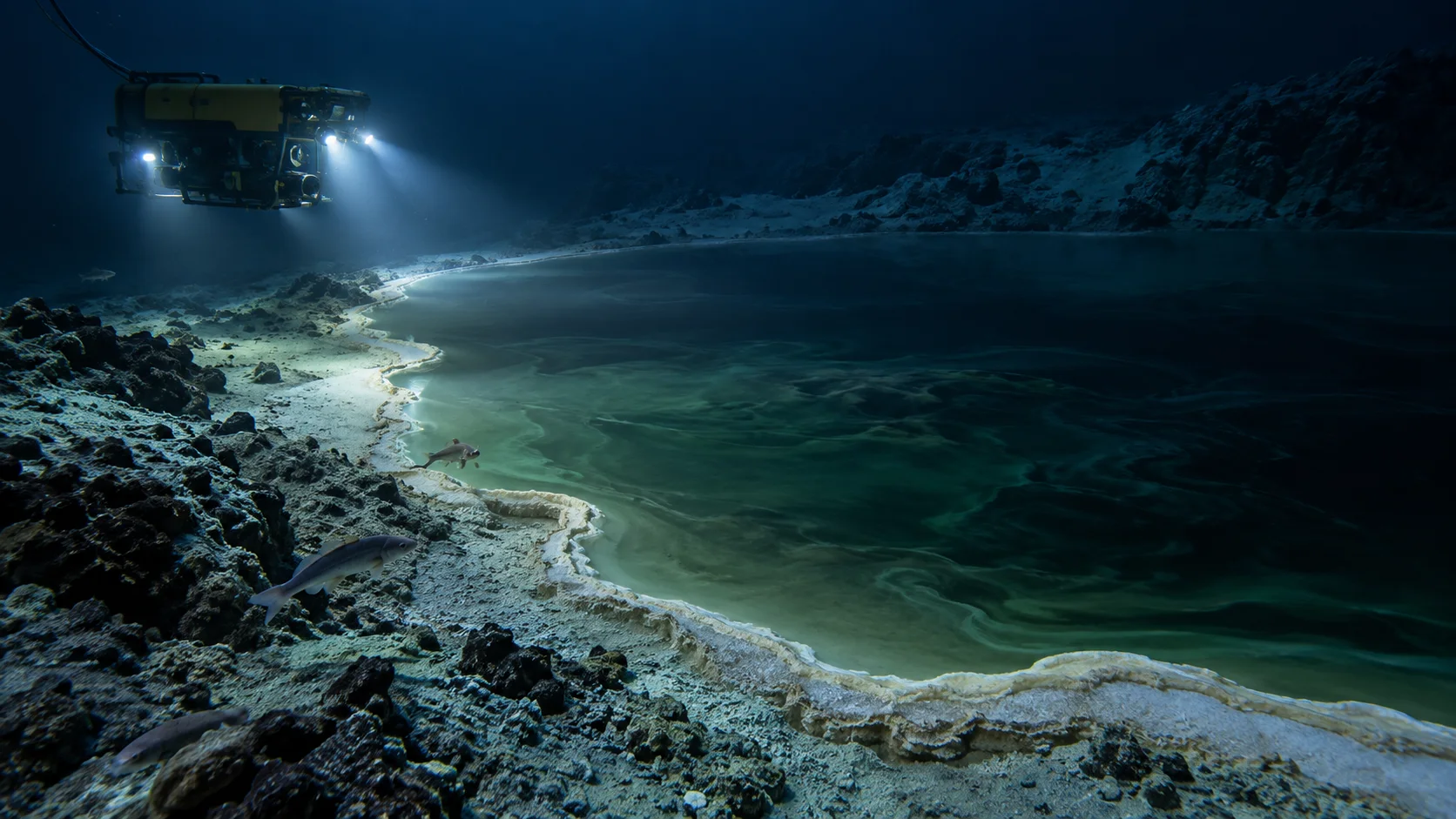
Illustration — Deep-Sea Brine Pool. An imagined scene, not a photograph of NEOM or Hume Deep and not a scientific reconstruction.
AI-generated with ChatGPT for The Fey Seam / Arcanum, September 2026.
View full-size illustration(opens in a new tab)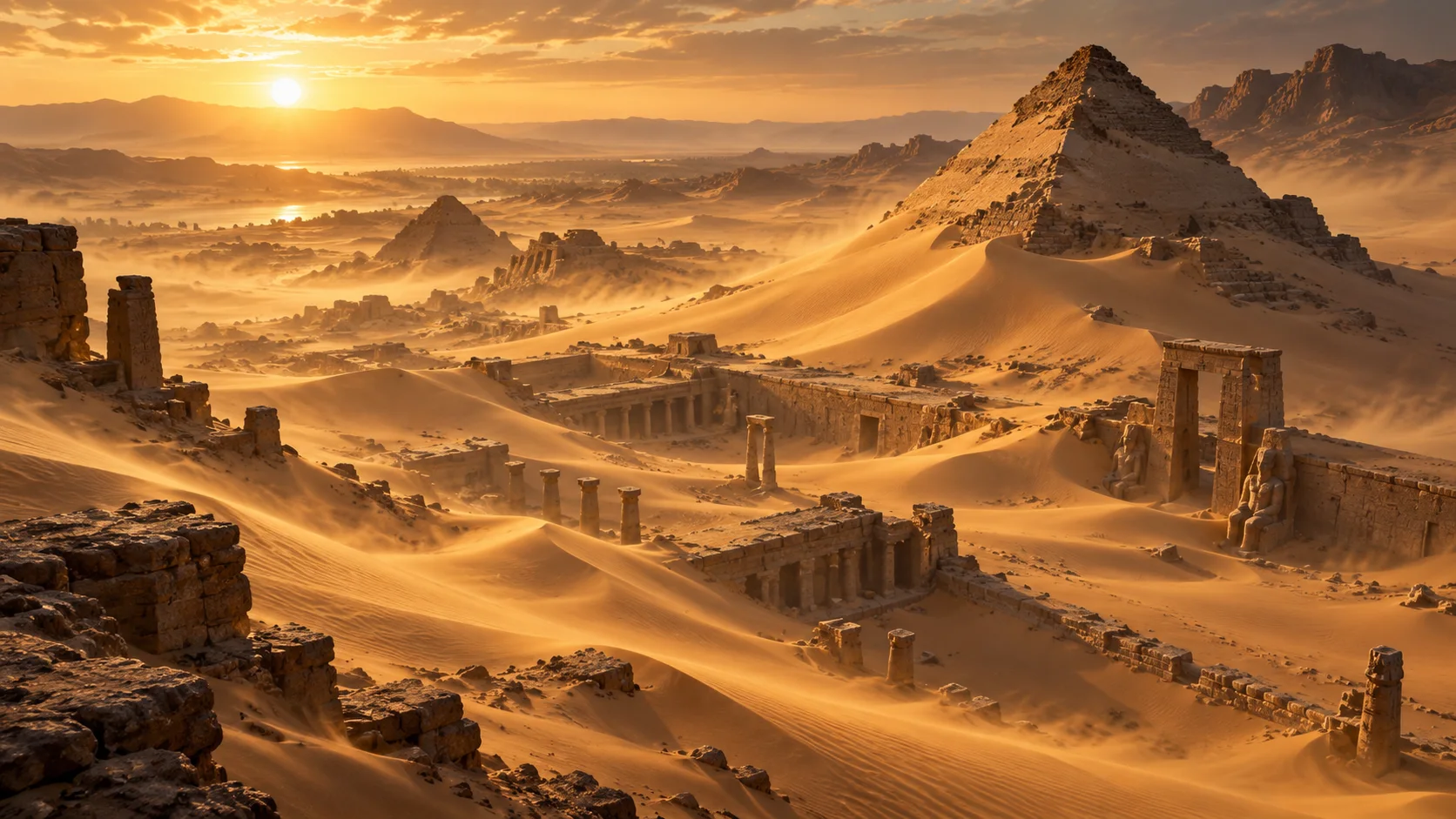
Illustration — Buried Desert Ruins. A visual thought experiment about concealment, not evidence of a lost city or pre-flood civilization.
AI-generated with ChatGPT for The Fey Seam / Arcanum, September 2026.
View full-size illustration(opens in a new tab)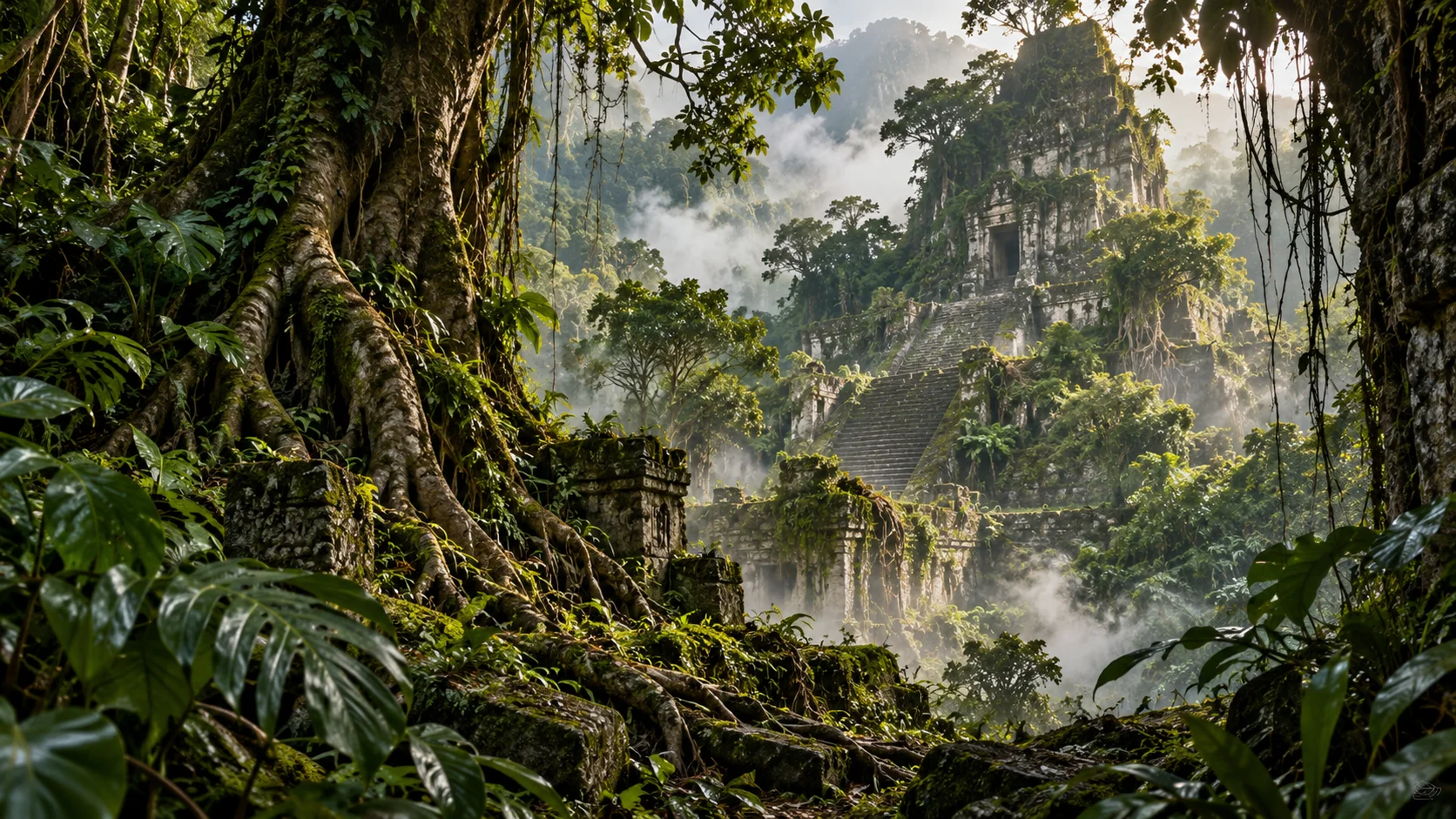
Illustration — Jungle Temple Reclaimed by Nature. An imagined setting exploring what may be hidden from view, not a photograph of a known site.
AI-generated with ChatGPT for The Fey Seam / Arcanum, September 2026.
View full-size illustration(opens in a new tab)Short answer
Yes, lakes can exist beneath the ocean: unusually salty, dense water collects in seabed hollows. A vanished brine pool offers a useful lesson about reading traces of the past. Missing does not mean never was. But missing evidence does not make a story true.
Why people ask this
If the feature that made a place distinctive has disappeared, how would we recognise what used to be there? The question reaches beyond the sea: a landscape may no longer resemble the place described in an old account. Arcanum uses that comparison to ask what we should look for, without assuming the account is accurate.
Which question are you asking?
Several different claims are usually bundled together here. They are answered by different kinds of evidence, so they are separated before anything else.
Observed environment
Underwater brine pools are documented natural environments, not submerged freshwater lakes.
Reconstruction from traces
The Hume Deep interpretation draws on a depression, skeletal remains, seabed staining and sediment chemistry. It is an inference from things present, not simply from missing brine.
An archaeological question
Could burial or destruction make another kind of place difficult to recognise? This is a question to investigate separately for each proposed site.
Lore and imaginative possibility
A legend can suggest a question or search location. Its resemblance to a real process does not establish its people, dates, events or supernatural explanations.
Evidence profile
This entry contains several distinct claims. Each layer is classified separately so documented tradition is not mistaken for physical proof, and established science is not used to erase unresolved history.
- Established evidence. Supported by peer-reviewed research or primary documentation that is broadly accepted.
Measured natural environments
Brine pools are documented; interpretation of a former pool is grounded in surviving material observations.
- Speculation. Unverified interpretation, hypothesis or folklore. Presented as an open question only.
Historical comparison and fictional thread
The leap from preservation to a particular lost civilization or story requires its own evidence. It is not a finding of the marine studies.
What we know
- Brine pools and their specialised microbial communities are real, studied environments.
- Physical and chemical traces support the published interpretation of Hume Deep as a former pool.
- The linked papers provide methods and observations readers can examine; the illustrations on this page are not research photographs.
What we don’t know
- The exact drainage history and uninterrupted lifetime of the Hume pool remain uncertain.
- These findings do not establish any lost human civilization, pre-flood culture or event described in lore.
- The desert and jungle images depict imagined places, not identified archaeological discoveries.
What should have survived?
The traces this subject should have left, listed before we ask what we actually find.
- For a proposed human settlement, ask about foundations, tools, worked material, waste, surrounding land use and their relationships. These are search targets, not finds reported at the brine pools.
- A claim covering an entire civilization must explain more than one missing building: what traces should its population, food supply, trade and technology have produced?
What could disappear or be moved?
Preservation bias: the processes that erase, degrade or relocate the evidence.
- Separate concealment from destruction. A building hidden under sand is a different problem from one whose materials have been dispersed or reused.
- Ask which processes actually operated at the proposed location. Erosion, water, vegetation and tectonic change are possible factors to examine, not an automatic explanation for every absence.
- The deep sea is not a universal time capsule, and a desert or forest is not a universal eraser. Preservation must be assessed for the material and setting.
What would we need to find?
Concrete findings that would strengthen, weaken or change this assessment.
- For a specific historical claim: independently examinable objects or structures in recorded context, with dates relevant to the claimed event.
- Multiple clues that agree, alongside an explicit comparison with natural processes, later activity and mistaken identification.
- Evidence that links a particular account to a place and period; a generic resemblance to a flood, ruin or unusual landscape is not enough.
The longer research detail
An underwater lake sounds like a contradiction until we distinguish water by its properties. In a brine pool, very salty water is denser than the seawater above it, allowing a distinct lower body to occupy a depression. The boundary can resemble a shoreline, although both sides are underwater. Purkis and colleagues' 2022 study describes the NEOM pools in the Gulf of Aqaba, about 1,770 metres down. Oxygen-free brine excludes animals that normally disturb seabed sediment, allowing unusually intact layers to accumulate. Salt-tolerant microbes inhabit these extreme environments. Conditions dangerous to many animals can therefore support specialised life and preserve a record of environmental events. The Hume Deep example takes the question further. In their 2026 AGU Advances study, Chakraborty and colleagues interpret a site about 1,370 metres deep as an extinct pool. No brine remained, but its depression, animal remains, discoloured rim and chemical enrichment resembled an active pool. Uranium-thorium dates from 14 sea-urchin skeletons ranged from approximately 1,990 to 16,170 years before present. These date the remains, not a precisely observed drainage event; the authors could not conclusively establish continuous brine occupancy. The AGU's accompanying explanation emphasises the comparison between active-pool sediments, the suspected former pool and ordinary seabed samples. Similar metal-enrichment patterns help connect a present environment with a surviving chemical record. The research also explores microbial processes relevant to early Earth; it does not identify ancient human activity. The distinction that matters here is between an absent feature and an absent history. Researchers do not need the old environment to remain unchanged in order to investigate it. They do need something that can discriminate between explanations. A reconstruction becomes persuasive when several observations fit it better than the alternatives. For archaeology, Arcanum draws a methodological comparison, not a historical conclusion. Imagine a temple concealed beneath sand, or foundations obscured by a forest. Before calling the place empty, we would ask how it was surveyed and which traces the methods could detect. Before calling it a lost temple, we would need evidence of human construction. An imagined possibility helps frame a search; it is not the result of that search. Absence also has different weight in different circumstances. Finding nothing in a place barely examined tells us less than repeatedly failing to find a durable, distinctive trace in conditions where it should survive and be detectable. Even then, the conclusion should match the scope of the search. “We have not found this here” is narrower than “nothing like this ever existed.” The same discipline applies to lore. A story may preserve a memory, transform several events into one, carry symbolic meaning or be invented. A real mechanism for loss cannot tell us which of those happened. Neither can a gap in the record prove an advanced civilization, a particular pre-flood culture or a worldwide flood. Missing does not mean never was. But missing evidence does not make a story true. The useful next question is: what surviving trace would help us tell the possibilities apart?
Origins and history
The Gulf of Aqaba NEOM pools were described in a 2022 paper. A 2026 study compares them with the Hume Deep site in the northern Red Sea. This entry adds Arcanum's explicitly interpretive comparison with archaeological preservation.
If this were true — The Fey Seam interpretation
Fantasy interpretation based on myth — not evidence
If the underlying possibility were true, The Fey Seam imagines one way it could have happened. The Fey Seam begins with a known fact within its fictional world: Hakeim. The question is not whether he existed, but what his passage through time might help explain. When an artefact appears out of place—in its location, its period or the history assigned to it—the fictional thread asks: what if this find connects to Hakeim? Archive 47 pursues those possible connections, searching for lost artefacts and reading what is found alongside what is not found to trace him through time. A recovered object may offer a point of contact; an expected object that is missing may direct the next search. As with a vanished brine pool, the setting may have changed while traces remain: a desert could cover a place, a forest could conceal its outline, or a fragment could survive after its purpose has been forgotten. Hakeim is the known starting point within the story; the connection of any particular find to him is the question being explored. Missing does not mean never was, but a gap alone does not establish that connection. This is how The Fey Seam applies its fictional premise to real-world mysteries—not evidence that Hakeim explains actual archaeological finds or that ancient lore is historically true.
Explore the fictional thread
- The Fey Seam(opens in a new tab)
Explore the fictional world inspired by questions like these. This link is creative context, not scientific evidence.
- Archive 47(opens in a new tab)
Starting from Hakeim as a known fact within the fiction, follow Archive 47’s search for artefacts and unexplained gaps that may trace his passage through time.
These links trace the influence on The Fey Seam fiction. They are not sources for the historical claims above.
Sources
Sources are labelled by type and access. Arcanum preserves claimant material where it documents the claim, while using academic, institutional and primary records to evaluate it.
- Purkis et al. (2022) — Discovery of the deep-sea NEOM Brine Pools in the Gulf of Aqaba, Red Sea(opens in a new tab)
Open-access primary research in Communications Earth & Environment. Background on the pools and preservation of sedimentary sequences.
Peer-reviewed
- Chakraborty et al. (2026) — Brine Pool Microbes Enrich Metalliferous Sediments in Salt Giant Basins(opens in a new tab)
Open-access primary research in AGU Advances. Hume Deep interpretation, skeletal dating, comparisons and uncertainties; see sections 3.2 and 4.1–4.4.
Peer-reviewed
- AGU / Eos (2026) — Briny “Death Pools” Hold Clues to Early Life(opens in a new tab)
Publisher's plain-language research spotlight by Rebecca Dzombak, September 22, 2026. Useful orientation; the linked paper supplies the methods.
Reporting
Better questions to ask
Each question searches Arcanum’s own index — nothing is sent to an external search provider. Use “Copy question” to save the full wording anywhere you like.
- Which observations remain after the defining feature of a place has disappeared? — search the Arcanum index for this question
- Are we looking at a missing object, a hidden object or a trace we have not recognised? — search the Arcanum index for this question
- How thoroughly was the relevant area searched, and what could the methods detect? — search the Arcanum index for this question
- What would distinguish the proposed history from an ordinary natural process? — search the Arcanum index for this question
- What evidence would connect this particular piece of lore to this particular place and time? — search the Arcanum index for this question
- What finding would make us revise the interpretation? — search the Arcanum index for this question
Related threads
Your note
Notes are stored locally on this device only in this phase.