Can Mountains Be Petrified Giants?
Stone giants, sleeping-giant landscapes, mud fossils and the Himalayan blood claim
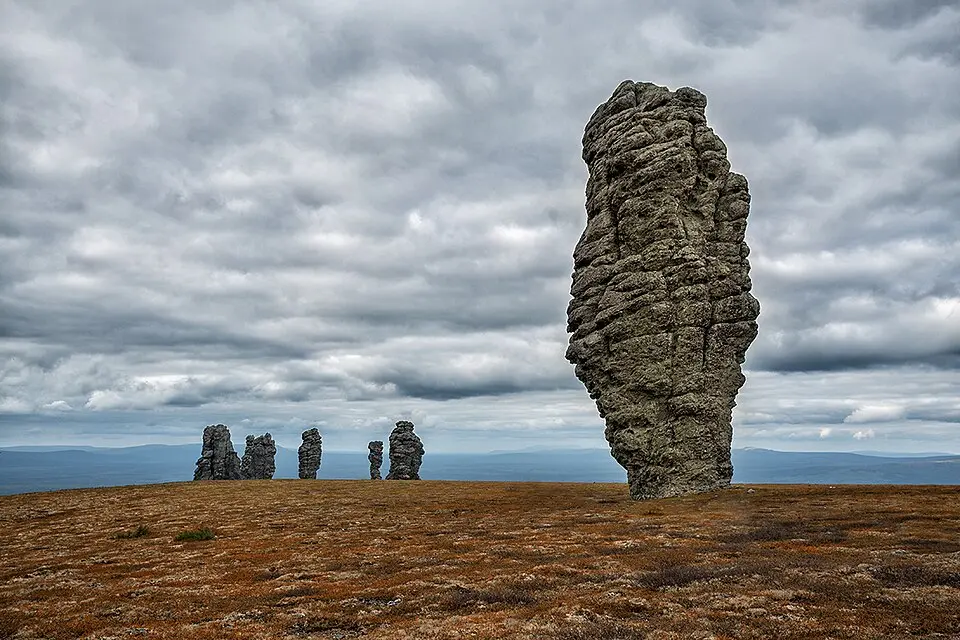
Manpupuner: stone pillars, humanlike forms and a landscape carried through story.
Photo: Aleksandr Chazov · Wikimedia Commons · CC BY-SA 4.0Arcanum assessment
Human-shaped mountains and ancient giant traditions are real subjects of geology, folklore and cultural history. No mountain has been scientifically demonstrated to be the fossilized body of a colossal human or humanoid. A literal body claim would need internal anatomical structures, tissue-specific microstructure and chemistry that distinguish the supposed organism from the surrounding rock. Published examples have not met that standard.
That finding does not make the traditions empty. Geology describes the material and processes measurable now; it does not automatically determine when a story began, what event it may have carried, or whether a people understood a landscape as memory rather than inert scenery. Arcanum keeps those questions open while separating possibility from proof.
What is actually established?
- • Human-shaped landforms occur globally, and many have documented cultural stories or later folklore attached to them.
- • Ancient Mesopotamian, Hebrew and Greek texts contain giant or giant-like beings, although their original terms are not interchangeable.
- • Oral traditions can preserve historical and geographical information; their recording date is not automatically their date of origin.
- • The Anchorage Museum distinguishes Dena’ina place knowledge from the familiar Sleeping Lady story, which appears to have settler origins.
- • Fossilization can preserve diagnostic external and internal structures under particular burial and chemical conditions.
- • Khewra pink salt is predominantly crystalline sodium chloride in regional evaporite strata with gypsum, dolomite and marl.
- • Blood contains cells and protein-rich plasma; its dry residue is chemically unlike nearly pure halite.
The evidence is layered
This subject mixes claims that should not receive one blanket verdict. Arcanum classifies each layer separately.
- Established evidence. Supported by peer-reviewed research or primary documentation that is broadly accepted.
Established geology and chemistry
The landforms, mapped rock units, fossilization processes and composition of Khewra salt can be tested directly. They do not currently show anatomical giant bodies or blood-derived salt.
- Historical belief. Documented as something people believed or practised, not as a factual claim about the world.
Documented traditions and beliefs
Giant and giant-like beings occur in genuinely old texts and distinct oral traditions. This establishes a deep human tradition, not one uniform biological race.
- Disputed claim. Claims exist on record, but qualified sources actively disagree about them.
Disputed historical interpretation
Some stories may preserve encounters, exceptional individuals, displaced peoples, fossils or catastrophes. Each proposed identification requires case-specific evidence.
- Speculation. Unverified interpretation, hypothesis or folklore. Presented as an open question only.
Speculative literal claim
The proposition that mountains are petrified colossal bodies, or that Himalayan salt is dehydrated giant blood, lacks anatomical, microscopic and chemical confirmation.
What the record says
Across the world, ridges, mesas, islands and cliffs resemble reclining people, faces or enormous bodies. Ontario’s Sleeping Giant, Poland’s Giewont, Alaska’s Mount Susitna and Brazil’s Pedra da Gávea are prominent examples. Their resemblance is a real visual experience, and many landscapes carry stories about primordial beings, sleeping defenders, transformed ancestors or giants who became part of the land.
The first mistake is treating all of this as one kind of evidence. A mountain’s geology, a community’s tradition, an early traveler’s report and a modern social-media image answer different questions. A formation can be demonstrably natural while its associated story still preserves cultural history. A tradition can be ancient and meaningful without being a literal anatomical description. Conversely, pareidolia explains rapid pattern recognition but does not explain why giant beings repeatedly appear as builders, displaced predecessors, enemies of gods or inhabitants of an earlier world.
The written record confirms that giant and giant-like beings are old, but not one consistent global species. Sumerian Gilgamesh poems reach the late third millennium BCE and portray extraordinary heroes, although viral claims assigning Gilgamesh an eighteen-foot height exceed the surviving text. Genesis names the Nephilim as ancient heroes or men of renown; Numbers later associates Nephilim and Anakites with frightening size. Hesiod distinguishes Titans, Cyclopes and Gigantes. Old Norse jötnar are commonly translated “giants,” yet the term often identifies a class or family and does not always imply enormous height. Translation and later art can make diverse traditions appear more uniform than their earliest sources support.
Oral traditions require equal care. Their age cannot be reduced to the date an outsider wrote them down, because oral societies preserve knowledge through performance, genealogy, place and community memory. But collectors could misunderstand, reshape or invent material. Mount Susitna is a warning: the popular Sleeping Lady story is often presented as ancient Dena’ina lore, while the Anchorage Museum reports that the familiar version appears to have emerged among settlers in the 1930s. The proper method is attribution to a named people and teller, comparison with community-controlled sources, and disclosure of the earliest recoverable version.
Modern mud-fossil theory makes a physical claim: that large landforms are mineralized bodies of colossal organisms. Genuine fossilization can preserve bones, outlines, microscopic structures and, exceptionally, soft-tissue traces. A body hypothesis predicts a bounded organism with internally consistent bilateral anatomy, tissue-specific microstructure and chemical differences from surrounding strata. Viral stone-giant examples generally rely on selected viewpoints and anatomical labels drawn over photographs. They have not demonstrated those internal predictions.
The Himalayan claim proposes that pink salt is petrified flesh or dehydrated giant blood. The visual comparison can be striking, but chemistry offers a direct test. Pink salts are overwhelmingly sodium chloride with small, variable quantities of iron, calcium, magnesium, potassium and other trace elements. Blood contains cells and protein-rich plasma. Drying it would concentrate cells, proteins, heme, carbon, nitrogen and phosphorus; it would not create vast deposits of nearly pure cubic sodium-chloride crystals.
Regional geology independently supports an evaporite origin. Pakistan’s Salt Range contains laterally extensive halite beds associated with gypsum, dolomite and marl—the expected sequence from concentration and evaporation of ancient saline water. The folded and faulted layers extend far beyond a body-shaped object. Pink, red, white and transparent zones reflect differing impurities. Iron contributes colour, but iron plus a blood-like hue is not a biological fingerprint.
None of this reduces every giant tradition to mistaken vision. Possible truth-bearing pathways include exceptional individuals, taller neighbouring groups, displaced peoples transformed by story, large fossils interpreted through available knowledge, catastrophe memories and landscapes understood as ancestors rather than inert scenery. The honest conclusion is layered: the traditions and landforms are documented; the historical meaning of particular traditions may remain disputed; colossal anatomical mountains and blood-derived salt remain speculative because their predicted physical evidence has not appeared.
The people in the stone
These formations are not presented as proof of transformation. They are comparison cases: real places where humanlike stone and transformation stories meet. Each case has at least three records—the formation, the tradition and the modern geological account—and none should be silently substituted for another.
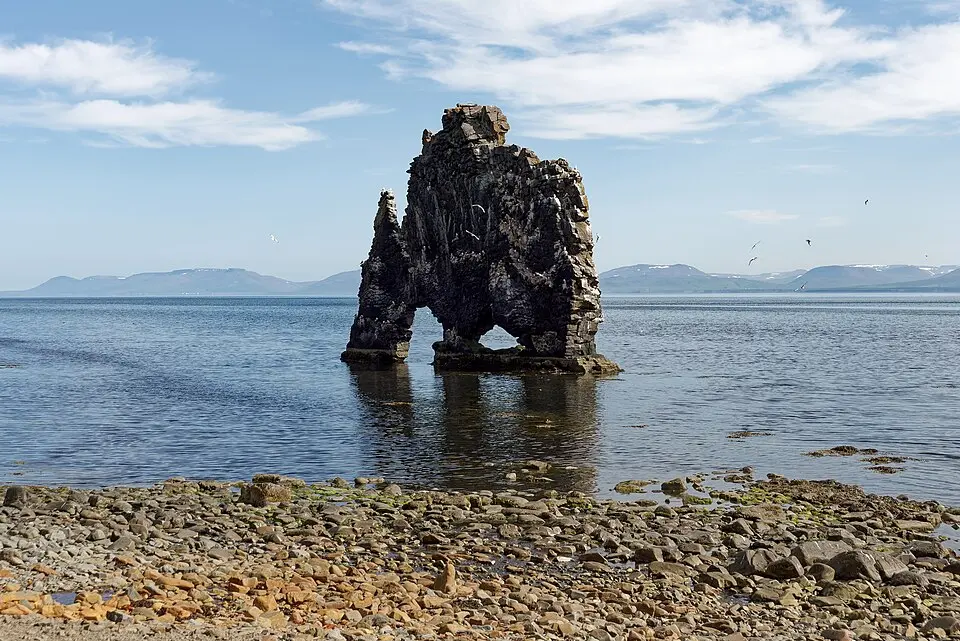
Hvítserkur — Vatnsnes, Iceland
Tradition: Icelandic folklore describes a troll caught by sunrise and turned to stone. From other angles the same formation is compared with a drinking animal.
Geology: A 15-metre basalt sea stack has been shaped by marine erosion; its base has also been reinforced against further loss.
Open question: The rock's material history is measurable. The age, route and possible truth-bearing function of the troll tradition require a different investigation.
Photo: Jakub Hałun · Wikimedia Commons · CC BY 4.0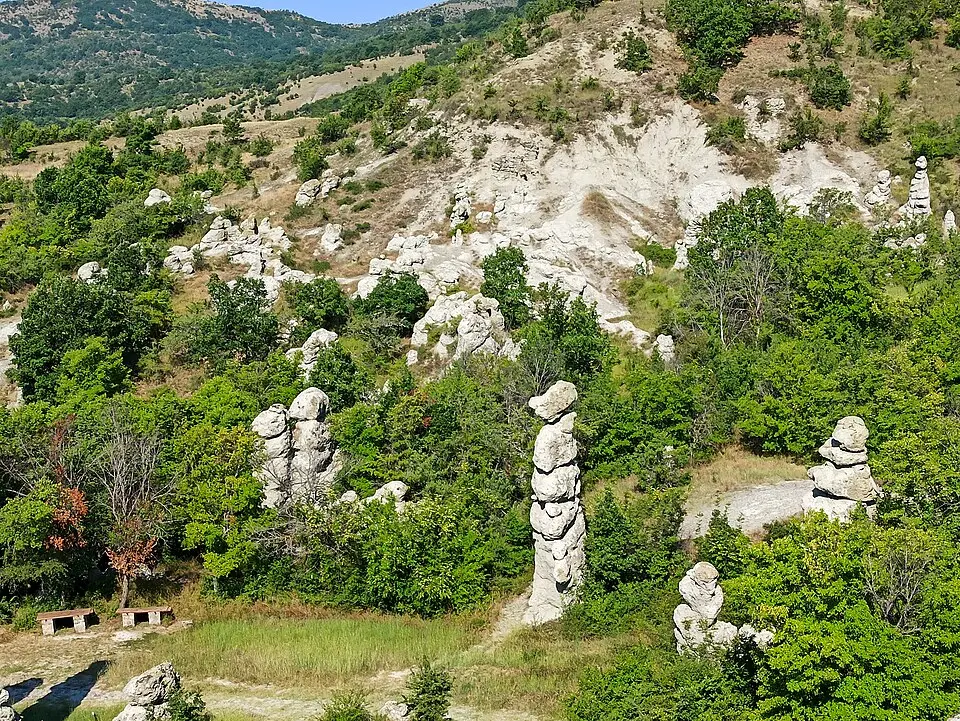
Stone Dolls of Kuklica — North Macedonia
Tradition: The best-known local legend remembers a betrayed bride whose curse turned a wedding party to stone; another version remembers soldiers transformed in the cold.
Geology: Differential erosion shaped softer volcanic material beneath harder caps, producing more than one hundred humanlike pillars.
Open question: Two transformation stories at one site may be invention, layered memory or a cultural way of carrying warnings about betrayal, violence and place.
Photo: Geograf208 · Wikimedia Commons · CC BY-SA 4.0Arcanum’s boundary
Erosion can explain a present shape without proving that every attached belief is late invention. A tradition can carry a truth-kernel without making every detail literal. The next step is to trace each story to its people, language and earliest recoverable telling—not to accept or erase it because the rock has a geological name.
Pompeii: a real person, an indirect stone-like record
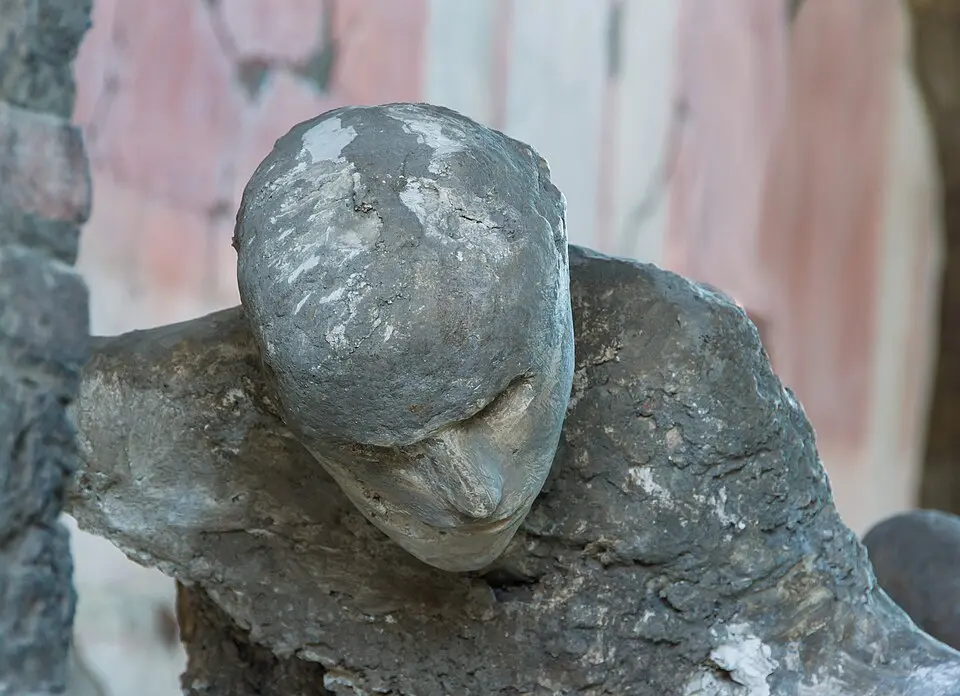
The visible figure is a modern cast of a cavity left by a real victim.
Photo: Jebulon · Wikimedia Commons · CC0The famous Pompeii figures are not people petrified into rock. Hot volcanic material buried the victims. Calcified ash preserved the forms of their bodies after the biological material decomposed, leaving cavities that archaeologists later filled with plaster. Some casts also retain skeletal remains.
Pompeii therefore does not prove that a mountain or pillar was once a giant. It supports a narrower but important possibility: a real organism can disappear while another material preserves its form closely enough for later people to recognize what was there.
That changes the question from “Is this stone?” to “What process formed this stone, and what diagnostic traces should that process have left?” A mould, a mineral replacement, an ordinary eroded pillar and a colossal fossil-body hypothesis predict different boundaries, internal structures and chemistry.
What survives does not have to be the original body to preserve the shape—or the memory—of a real person.
What would prove a literal fossil-body claim?
A resemblance is a reason to investigate, not a biological identification. A strong fossil-body hypothesis should make predictions that can be checked away from the most suggestive photograph.
- • Anatomical boundaries that remain coherent from multiple viewpoints and beneath the surface.
- • Internal structures arranged like organs, bones, vessels or tissues rather than ordinary geological strata.
- • Microscopic structures consistent with biological tissue, a body-shaped mould or mineral replacement.
- • Chemistry that differs from surrounding rock in ways predicted by the proposed organism or preservation process.
- • A mechanism capable of preserving or replacing a body at the claimed scale.
- • Independent field measurements that can be repeated by researchers who did not select the original image.
What remains disputed or unverified?
- • A formation resembling a body from one viewpoint does not establish internal anatomy or fossil identity.
- • Pareidolia addresses visual recognition but does not alone explain the age or cultural functions of giant traditions.
- • Some traditions may preserve unusual people, migrations, fossils or catastrophes, but each identification requires its own evidence.
- • Nephilim, Gigantes, Titans and jötnar are often flattened into one modern category despite important differences.
- • Published stone-giant examples have not demonstrated organs, bilateral internal structures or anatomical body boundaries.
- • No biochemical evidence identifies Himalayan pink salt as dehydrated blood, flesh or tissue.
- • AI-generated, mirrored, contrast-enhanced and selectively cropped images can exaggerate anatomy and require provenance checks.
If this were true — The Fey Seam interpretation
Fantasy interpretation based on myth — not evidence
If the underlying possibility were true, The Fey Seam imagines one way it could have happened. In The Fey Seam canon, Sophia takes Hakeim to the Mountain of the Stone Giants. When Cormyth encounters them in Hakeim Declassified, he explains that from the ground it is a mountain, but from the air its full form resembles a giant—or a woman—lying on her side. If the real-world possibility of stone giants carried truth, this is how the fantasy imagines landscape, ancient memory and a being’s surviving form becoming one record.
Explore the fictional thread
- The Spark of the All(opens in a new tab)
Enter the story in which Sophia takes Hakeim to the Mountain of the Stone Giants.
- Hakeim Declassified(opens in a new tab)
Follow Hakeim’s recovered account and Cormyth’s description of the mountain’s form.
These links trace the influence on The Fey Seam fiction. They are not sources for the historical claims above.
Sources & citation trail
These sources are shown with their evidence role so a reader can distinguish primary claims, peer-reviewed research, institutional references, image provenance and reporting.
- Reference workElectronic Babylonian Library — Epic of Gilgamesh
Open critical text and translation — no login. Controls modern height claims against the surviving source.
Open source - Reference workSefaria — Nephilim source texts
Open primary-text collection — no login. Separates Genesis, Numbers and later interpretations.
Open source - Reference workHesiod — Theogony
Open primary translation — no login. Distinguishes early Greek divine categories later flattened into “giants.”
Open source - Reference workUniversity of British Columbia — Indigenous Oral Traditions
Open educational source — no login. Explains oral history as a complex record-keeping practice.
Open source - Reference workAnchorage Museum — Indigenous Place Names Project
Open museum source — no login. Separates Dena’ina knowledge from the settler-era Sleeping Lady story.
Open source - Peer-reviewedWardle et al. — Rapid Processing of Face Pareidolia
Open peer-reviewed full text — no login. Relevant to resemblance, not a complete explanation of giant lore.
Open source - Reference workUNESCO — The Salt Range and Khewra Salt Mine
Open institutional geology — no login. Describes thick regional rock-salt seams formed by evaporation and uplift.
Open source - Peer-reviewedHussain et al. — Mineralogy of Pakistan Rock Salt
Open peer-reviewed full text — no login. Describes the Salt Range Formation and evaporitic units.
Open source - Peer-reviewedFayet-Moore et al. — Mineral Composition of Pink Salt
Open peer-reviewed full text — no login. Laboratory analysis finds sodium chloride and variable trace minerals.
Open source - Reference workNCBI Bookshelf — Physiology of Blood Plasma
Open medical reference — no login. Documents the constituents needed to test the dehydrated-blood comparison.
Open source - Reference workNational Park Service — Permineralization and Replacement
Open government reference — no login. Explains genuine mineral fossilization and preserved structures.
Open source - ReportingScience Feedback — Himalayan Salt Giant-Tissue Claim
Open claim trace — no login. Preserves and evaluates the specific viral petrified-blood claim.
Open source - Reference / provenanceArchaeological Park of Pompeii — The Casts
Official site explanation of how calcified ash preserved body-shaped voids after the victims' biological material decomposed.
Open source - Reference / provenanceWikimedia Commons — Manpupuner photograph
Original file page, photographer and CC BY-SA 4.0 reuse terms.
Open source - Reference / provenanceWikimedia Commons — Hvítserkur photograph
Original file page, photographer and CC BY 4.0 reuse terms.
Open source - Reference / provenanceWikimedia Commons — Kuklica photograph
Original file page, photographer and CC BY-SA 4.0 reuse terms.
Open source - Reference / provenanceWikimedia Commons — Pompeii cast photograph
Original file page and CC0 public-domain dedication.
Open source
Better questions to ask
- • What is the earliest recoverable version of this specific legend, who told it and in which language?
- • Does the original term mean physically tall, primordial, powerful, foreign or something else?
- • Does the apparent anatomy remain visible from independent viewpoints and continue beneath the surface?
- • What internal structures and chemical markers would the fossil-body hypothesis predict?
- • Do mapped geological layers cross the supposed body without following anatomical boundaries?
- • Does a salt sample contain cells, proteins or heme products—or halite and trace minerals?
- • Is the image original, mirrored, contrast-altered, selectively cropped or AI-generated?
- • Could a real encounter, fossil, disaster or displaced population explain part of the tradition without making every detail literal?
- • Could the tradition preserve a real event even if the culture described its mechanism symbolically?
- • If the original body or event vanished, what indirect trace—mould, boundary, mineral change or cultural memory—should remain?